Cesky: |
Warning: Planned shutdown of this website on 12/31/2029.
Panda's DIY
Originally, I am an electrician-slash-engineer, so I occasionally get caught up (besides software engineering) in electronics development, especially microchips. The results are not profie, but maybe I will inspire someone in his creation. Above all, I try to aim with the style "a lot of music for little money" = getting the most out of a simple device. I mainly focus on ATmega processors, but recently I got hooked on Raspberry Pico and CH32V00x.
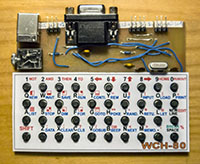 |
WCH80 - Clone of the ZX80 computer with the CH32V002 processor. |
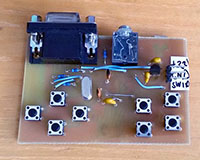 |
CH32LibSDK - SDK library for low-end CH32 RISC-V microcontrollers. |
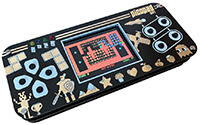 |
PicoLibSDK - Alternative Extended C/C++ SDK library for Raspberry Pico and RP2040. |
 |
DispHSTX - DVI (HDMI) and VGA display driver for Pico2 RP2350, using HSTX peripheral. |
 |
Pico16VGA - 16-colour VGA display on Raspberry Pico for analogue VGA monitor and digital LCD panel. |
 |
ATX-80 - Clone of ZX-80 computer with ATmega8, ZX-80 BASIC bios rewritten into AVR code. |
 |
AT4004 - Intel 4004 and 4040 4-bit processor development kit with Busicom 141-PF calculator emulation |
 |
PicoQVGA - minimalistic QVGA display on Raspberry Pico |
 |
PicoVGA - VGA/TV display on Raspberry Pico |
 |
RaspPicoSDK - Easy compilation of Raspberry Pico under
Windows RaspPicoAsm - Assembler on Raspberry Pico and instruction timing measurement |
 |
ATpad - Gaming console with ATmega8 processor. Output to TV (PAL, NTSC) or VGA monitor. Running programs from SD card. Port with 2 digital inputs/outputs and 2 analogue inputs (analogue joystick connection possible). |
 |
ATX-81 - A clone of the ZX-81 computer, an unfinished semi-finished product for inspiration. |
 |
ET-57 - Clone of TI-57 calculator with ATmega8 processor. |
 |
ET-57M - programmable mini-calculator. Clone of TI-57 calculator with ATmega8 processor. |
 |
ET-58 - Clone of TI-58 calculator with ATmega328 processor. |
 |
TI58T tiny - Replica of TI-58C calculator with ATmega8 processor. Accuracy of calculations to 19 valid digits, exponent 4 digits. UNFINISHED |
 |
TI59R revival - Upgrade of TI-59 calculator with ATmega644P processor. Accuracy of calculations to 19 valid digits, exponent 4 digits. UNTESTED |
 |
RBox - Reference resistor decade 0.1%. |
 |
FreqGen - Frequency function generator with ATmega8 processor (1 Hz to 8 MHz). |
 |
FreqMeter - Precise frequency meter with ATmega8
processor (1 Hz to 50 MHz, or 1 Hz to 100 MHz). FreqMeterInfo - description of the method of accurate frequency measurement. |
 |
RCLmeter - Meter for resistors, capacitors, coils, ESR, voltage and short circuit indicator, with automatic range change. |
 |
Simple DC voltmeter - 2 inputs (10V and 100V ranges) are captured using an A/D converter and displayed as 2 values on the EL1602B LCD display. There is no circuit board, only a schematic, it remains in the form of a sparrows nest.:-) |
 |
Microprocessor kit P84 - development environment, compiler and programmer for Microchip PIC16F84 processors. This project was started in 2000, at a time when PIC16F84 processors were the king of microchips in terms of low price, performance and low power consumption. The basis is a universal PIC16F84 unit that connects to a PC via a COM port and serves both to program the processor and as a test development board. Additional modules can be connected to the output connector - LCD display, LED array with buttons and speaker. To program the module, a PicDev compiler was created, compiling the program in assembler and allowing to write the program via COM port to the module. |
 |
CycloMet - is a measuring unit for various sports equipment. It measures run distance, displays run time, speed and total distance. It is powered by 2 pencil monocells and equipped with a PIC16F84 processor. It uses a 3 1/2 digit LCD display and is controlled by 1 button. |
 |
EyeWatch - watchdog of time spent on the computer. The module (with a PIC16F84 processor) monitors the time spent at the computer and if the limit is exceeded, it will alert you with a signal. Unlike the software solution, there are no problems of collisions with other running programs (e.g. fullscreen). When the computer is not in use, a screensaver is triggered to pause the time countdown. |
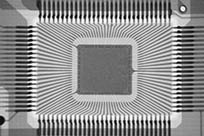 |
GDG Sharp - How Sharp GDG was dissected |
 |
Craft - Minimalist VGA demo with ATmega88 processor by Swedish author Linus Akesson. |
 |
Christmas lights with 320 LEDs - LEDs in 5 colours are arranged in a matrix of 8 x 8 segments and controlled by a multiplexer. Any of the LEDs can be controlled individually by software to achieve interesting effects. |
 |
PandaProg - universal programmer and tester for processors, memories and logic circuits ... UNFINISHED! |

